
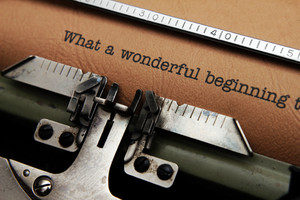
I take that back. Your story starts with the first page.
Oh wait, I mean, your story starts with the first paragraph.
No, sorry, my mistake. Your story starts with the first sentence.
The first SENTENCE. Okay, that makes more sense.
Your first sentence is your "hook" to luring the reader to pause all that they are doing and read your book.
Your hook from the first sentence widens into the first line, the first paragraph, the first page, and the first chapter. All very important in gaining confidence in your writing and success in ensuring your reader.
According to Noah Lukeman, in The First Five Pages, "... the job of the hook is to set the tone for the book..."
Lukeman cautions that the "Hook" is more than a marketing tool. "It can establish a character, narrator or setting, convey a shocking piece of information."
Priscilla Long writes in The Writer's Portable Mentor, "Often a good opening consists of a small sentence that concentrates into its short little self the essence (sometimes the central dramatic conflict) of what follows.
Long lists various ways to use the first sentence:
- Begin with an aphorism.
- Ask the central question of the piece.
- State directly what the piece is about.
- Establish your protagonist's connection to the subject matter at hand.
- Begin with a telling anecdote or quote.
- Rely on the reliable What? When? Where? Why? Who?
- Begin with a good title.
Long suggests that writers collect openings written by others. Keep a sentence book and collect these passages and study from them, learning from them.
K. M. Weiland writes in Structuring Your Novel: Essential Keys for Writing an Outstanding
Story, "The hook comes in many forms, but stripped down to its lowest common denominator, it's nothing more or less than a question. If we can pique our readers' curiosity, we've got 'em. Simple as that."
Writers want readers to ask, "What's going to happen?" Or, as K.M. Weiland writes, "Readers have to understand enough about the situation to mentally form a specific question. What the heck is going on here? does not qualify as a good opening question."
Your opening to your story must sell the story. You can have the best darn ending ever written but no one will ever read it if they're not hooked in your opening.
K.M. Weiland outlines the traits and parts of a good opening:
- Don't open before the beginning of the story. Don't dump your backstory in your opening.
- Open with characters; preferably the protagonist to connect your character with your reader.
- Open with conflict. Without conflict, you have no story.
- Open with movement. Keep your characters moving.
- Establish the setting to ground your reader in the physicality of the story.
- Orient readers with an establishing shot by presenting the setting and characters' positions within it in a sentence or two.
- Set the tone the reader to understand what type of story they are reading.
Openings give you the best and first
opportunity to make a profound statement about your story. It should include as
many of the following five parts as you can:
- Inherent Question
- Character
- Setting
- Sweeping Declaration
- Tone
Work on your opening lines. They should
introduce your story’s character, plot, setting, theme and voice and send the
reader on an unforgettable adventure.
James V. Smith, JR., outlines what a great opener might contain, in The
Writer’s Little Helper:
- A great first line
- Excitement: high action, high drama, high anxiety
- An intro to the heroic character
- An intro to the worthy adversary
- Problems that stand in the way of the heroic character achieving a worthy goal
- Your best writing style, to set the tone and to show you can write: action, conflict, imagery, dialogue, irony
- A feel for the story’s setting and atmosphere
- Foreshadowing of things to come
- Above all, a single overwhelming central problem that will only get worse until it appears incapable of being solved, a problem that will defeat the heroic character unless she defeats it in the Closer
A final word of caution from Smith, “Don’t press too hard with
these opening words. Just as in trying to meet someone you admire, it’s
possible to go breathless and appear needy if you try too hard. You’ll be
tempted to overwrite an overwrought opener if you’re not careful. Be cool. Be
natural. No matter how hard you have to work at it, make it look easy.”
REFERENCES:
The Writer's Portable Mentor by Priscilla Long
The First Five Pages by Noah Lukeman
Structuring Your Novel: Essential Keys for Writing an Outstanding
Story by K. M. Weiland
The
Writer’s Little Helper by James V. Smith, JR.


